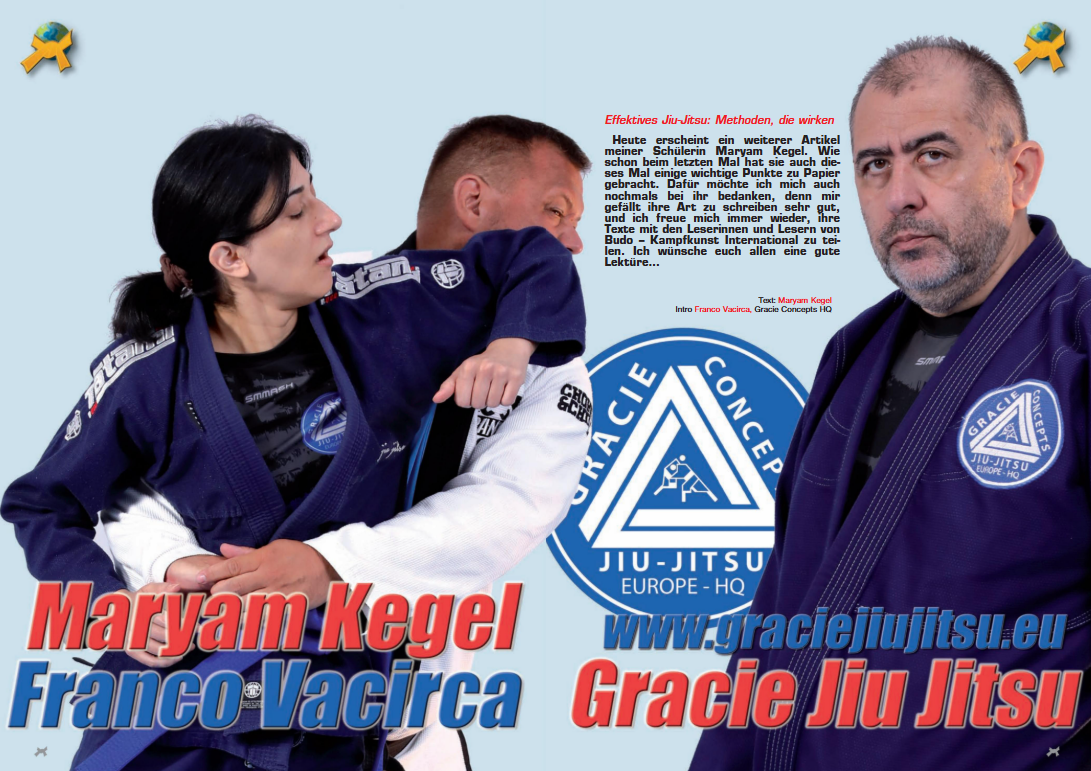
© Text von Maryam Kegel
© Einführung von Franco Vacirca, Gracie Concepts HQ
Heute erscheint ein weiterer Artikel meiner Schülerin Maryam Kegel. Wie schon beim letzten Mal hat sie auch dieses Mal einige wichtige Punkte zu Papier gebracht. Dafür möchte ich mich auch nochmals bei ihr bedanken, denn mir gefällt ihre Art zu schreiben sehr gut, und ich freue mich immer wieder, ihre Texte mit den Leserinnen und Lesern von Budo – Kampfkunst International zu teilen. Ich wünsche euch allen eine gute Lektüre…
Ein Ritual in Bewegung
Wir begrüssen uns auf der Matte mit einem klaren, kraftvollen OSS (OUS) – einem Zeichen von Respekt, Aufmerksamkeit und gemeinsamer Bereitschaft. Erst dann beginnt das Aufwärmen. Danach wird die Technik des Tages vorgestellt: ein Takedown, eine Submission, eine Positionskontrolle oder vielleicht ein Escape. Wir üben, wechseln die Partner, wiederholen – bis eine neue Technik hinzukommt oder die Verteidigung gegen die vorherige.
Zum Abschluss folgt das Randori: eine Gelegenheit, Technik, Timing und Kraft auf die Probe zu stellen. Keuchend und triefend vor Schweiss kommen wir zum abschliessenden OSS zurück – ein stilles Ritual, das das Training ebenso beschliesst, wie es begonnen hat.
Doch was man aus eineinhalb Stunden BJJ mitnimmt, hängt nicht nur vom eigenen Einsatz ab, sondern auch von der Art des Trainings.
In diesem Artikel werfe ich einen genaueren Blick auf Trainingsformen, die ich selbst erlebt habe – und auf das, was sie in mir ausgelöst haben. Entscheidend war für mich, dass sich die Zeit auf der Matte am Ende als wirklich wertvoll und wirksam angefühlt hat.
Mit oder ohne: Gi vs. Nogi
Zwei Varianten, ein Ziel: effektives Jiu-Jitsu.
Das Tragen des Gi ist im Brazilian Jiu-Jitsu mehr als nur Bekleidung – es ist Teil eines Rituals. Vom Binden des Gürtels bis hin zum «OSS», das am Anfang und Ende jeder Einheit gesagt wird, vermittelt das Gi-Training Werte wie Disziplin, Respekt und Ordnung. Es bringt Struktur, Kontrolle und eine Vielzahl an Grifftechniken mit sich. Es zwingt zur Präzision und fördert ein methodisches Vorgehen.
Gerade für Kinder ist das Training im Gi pädagogisch sinnvoll: Es verlangsamt das Tempo, schärft die Genauigkeit und macht Prinzipien wie Balance und Hebelwirkung konkret erfahrbar. Ich persönlich habe noch nie ein Kindertraining im BJJ ohne Gi erlebt.
Nogi dagegen wirkt freier, schneller – oft chaotischer, da es mehr Reaktion als Planung, mehr Körpergefühl als Griffkontrolle verlangt. Wer Nogi trainiert, entwickelt ganz automatisch mehr Athletik, Beweglichkeit und Timing, weil weniger Halt zur Verfügung steht. Ich kenne einige, die ausschliesslich Nogi trainieren – und das mit Überzeugung.
Nogi, also das Training ohne Gi, ist eine moderne Variante, die vor allem auf reale Anwendungssituationen zielt. Auf der Strasse trägt niemand einen Kimono. Kleidung ist oft glatt, ungreifbar, nicht standardisiert. Genau dafür wurde Nogi entwickelt: Um Techniken auch dann einsetzen zu können, wenn der klassische Griff fehlt.
Einige Submissions – etwa viele Würgetechniken – sind im Nogi schwerer umzusetzen und erfordern modifizierte Ansätze. Vieles muss neu geübt und angepasst werden. Der Fokus verschiebt sich: Weg von der Griffkontrolle, hin zur körpernahen Kontrolle.
In gewisser Weise steht Nogi näher an der Selbstverteidigung im Alltag – während das Training im Gi stärker die Wurzeln, die Prinzipien und die Philosophie des BJJ kultiviert.
In unserem Panda Gym (Berlin) stehen wöchentlich drei Einheiten mit Gi und zwei Nogi-Einheiten auf dem Trainingsplan. Auch auf den Trainingscamps mit Franco Vacirca wird häufig Nogi unterrichtet – einfach aus praktischen Gründen: Bei Reisen ist der Gi oft unhandlich oder fehlt ganz im Gepäck.
Beides hat seinen Platz auf der Matte. Für viele ergibt sich daraus kein «entweder – oder», sondern ein «sowohl – als auch». Tradition und Realität müssen sich nicht ausschliessen – sie ergänzen sich….
Hier zum vollständigen Artikel >
Effective Jiu-Jitsu: Methods that work
© Text by Maryam Kegel
© Introduction by Franco Vacirca, Gracie Concepts HQ
Today, another article by my student Maryam Kegel is being published. As last time, she has put some important points down on paper. I would like to thank her once again for this, because I really like her writing style and I am always happy to share her texts with the readers of Budo – Black Belt International. I hope you all enjoy reading it…
A ritual in motion
We greet each other on the mat with a clear, powerful OSS (OUS) – a sign of respect, attention, and shared readiness. Only then does the warm-up begin. After that, the technique of the day is introduced: a takedown, a submission, position control, or perhaps an escape. We practice, change partners, repeat – until a new technique is added or the defense against the previous one.
Finally, we do randori: an opportunity to put technique, timing, and strength to the test. Panting and dripping with sweat, we return to the final OSS – a silent ritual that ends the training as it began.
But what you get out of an hour and a half of BJJ depends not only on your own effort, but also on the type of training.
In this article, I take a closer look at the types of training I have experienced myself – and what they have triggered in me. The decisive factor for me was that the time on the mat ultimately felt truly valuable and effective.
With or without: Gi vs. Nogi
Two variations, one goal: effective Jiu-Jitsu.
Wearing the Gi in Brazilian Jiu-Jitsu is more than just clothing – it is part of a ritual. From tying the belt to saying “OSS” at the beginning and end of each session, Gi training conveys values such as discipline, respect, and order. It brings structure, control, and a variety of grip techniques. It forces precision and promotes a methodical approach.
Training in the Gi is particularly beneficial for children from an educational perspective: it slows down the pace, sharpens accuracy, and makes principles such as balance and leverage tangible. Personally, I have never seen children training in BJJ without a Gi.
Nogi, on the other hand, seems freer, faster—often more chaotic, as it requires more reaction than planning, more body awareness than grip control. Those who train in Nogi automatically develop more athleticism, agility, and timing because there is less support available. I know some who train exclusively in Nogi—and do so with conviction.
Nogi, i.e., training without a Gi, is a modern variant that focuses primarily on real-life situations. Nobody wears a kimono on the street. Clothing is often smooth, elusive, and non-standardized. This is exactly what Nogi was developed for: to be able to use techniques even when the classic grip is missing.
Some submissions – such as many choking techniques – are more difficult to execute in Nogi and require modified approaches. Much must be re-practiced and adapted. The focus shifts away from grip control to close-body control.
In a way, Nogi is closer to everyday self-defense, while training in Gi cultivates the roots, principles, and philosophy of BJJ more strongly.
At our Panda Gym (Berlin), the training schedule includes three Gi sessions and two Nogi sessions per week. Nogi is also frequently taught at training camps with Franco Vacirca – simply for practical reasons: when traveling, the Gi is often cumbersome or not included in the luggage at all.
Both have their place on the mat. For many, this does not result in an “either/or” situation, but rather a “both/and” situation. Tradition and reality do not have to be mutually exclusive – they complement each other….